
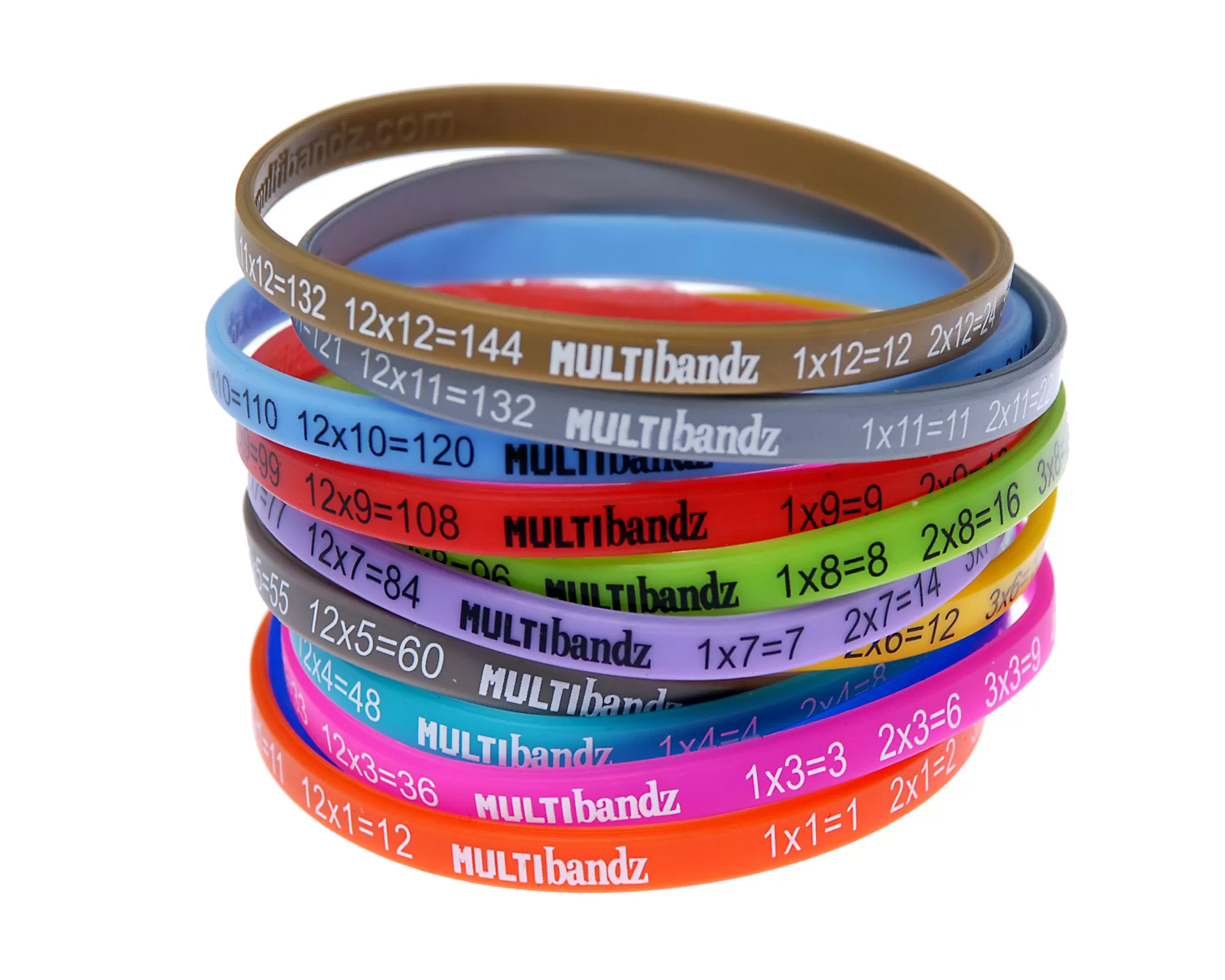

When the team at Dadzclub reviewed Multibandz a few years back, the headline was simple: “Finally, a maths-revision tool the kids actually want to wear.” That review still gets emailed to us every few months by parents asking if Multibandz are still the same product. Yes — same wristbands, same approach, same packaging. Just better-printed, more colours.
This article walks through what the Dadzclub review got right (most of it), what it underplayed (the social effect at school), and where parents in 2026 should actually start if their child is wrestling with times tables, division, or memorisation generally.
What Dadzclub Tested — And the Result
The Dadzclub review tested the original 12-pack times-tables Multibandz on three primary-school children aged 7-10. Each child wore one band per day for a week, swapping bands daily so they were exposed to all 12 times-tables in rotation.
Their results matched what we hear from teachers:
- Recall jumped most for the times-tables the child “already half knew.” The bands consolidated rather than created new memory.
- The 7-times and 8-times tables — the hardest ones — took longer. This is the well-known “mid-table dip” in primary maths.
- The youngest child enjoyed it most. The novelty factor was real for younger kids.
- Older siblings became unofficial coaches. This was the unexpected social benefit Dadzclub didn’t fully unpack.
Why Wristbands Beat Flashcards for Kids
Flashcards work, but only when the parent runs the session. The moment the parent is busy, flashcards stop. Multibandz keep teaching while the parent is making dinner, driving to school, or watching TV. The band is on the kid’s wrist for 8-10 hours a day — that’s a lot of incidental glances.
Cognitive psychologists call this spaced retrieval: short, frequent encounters with material you’re trying to memorise outperform long study sessions. A wristband delivers spaced retrieval automatically, no app subscription, no parent-driven session.
Read our in-depth Multibandz guide for the maths-pedagogy detail and our learning times tables strategy for the structured curriculum approach.
Recommended for you
Products related to this article
Hand-picked to go with what you just read.
The Order Most Australian Parents Choose
Looking at our 2025-2026 order data, the typical Multibandz purchase journey goes:
- First order: the basic 1-12 times-tables pack. Average customer is a parent of a Year 3-5 child whose teacher mentioned struggle with multiplication.
- Second order (4-8 weeks later): X Multibandz for the harder 13×-15× range, often once the child has aced the basic set.
- Third order (school year next): Dividerz, when division enters the curriculum — usually mid-Year 4 to early Year 5.
- Optional: Facts To wristbands for state-capitals, periodic-table elements, or whatever else the school is asking the child to memorise.
Schools typically order 25-50 packs and rotate them through Year 3-5 classes. If you’re a teacher reading this, the Schools Multibandz category lists bulk options. The broader Schools category covers everything else educational.
What the Dadzclub Review Missed: The Classroom Social Effect
The biggest unintended consequence of Multibandz, according to teachers we’ve spoken to, is what happens at recess. Kids compare wristbands. Kids who never voluntarily talked maths now compare which times-table they’re wearing. The 7-times-table band becomes a status symbol in some classrooms.
That’s gold, behaviourally speaking. Peer-driven motivation outperforms parent-driven nagging at every primary-school age. The wristband makes the maths visible to peers, which makes mastering it socially desirable.
When Multibandz Don’t Work
Honest truth — Multibandz aren’t a fix-all. They under-perform when:
- The child has a diagnosed maths-learning difficulty (dyscalculia). Specialist intervention is needed first.
- The child is anxious about maths. Forcing a visible reminder can amplify anxiety. Address the anxiety first.
- The child is too young for multiplication concepts. Bands are most effective ages 7-11.
- The parent treats the band as homework. The point is incidental learning — let the child wear and ignore it.
If your child is in any of these categories, talk to their teacher first. The wristband can still help — but as one tool among several, not the main intervention.
See our mastery-with-Multibandz approach for the full structured plan parents can follow.
Frequently Asked Questions
What age are Multibandz wristbands designed for?
Multibandz are designed for ages 7-11 (Year 2 to Year 6 in Australia). The size fits most primary-school wrists. They're most effective when multiplication is being introduced or consolidated in class.
How many wristbands come in a Multibandz pack?
The standard 12-pack contains one band for each times-table from 1 to 12. Larger school packs (25, 50, 100) repeat the bands so multiple students can wear the same table during a teaching unit.
Are Multibandz waterproof?
Yes — they’re solid silicone, the same material as a regular sports wristband. Kids can shower, swim, and play in them without damage. They will fade slightly after months of bright sun, but the printed numbers stay readable for years.
Can older students or adults use Multibandz?
The wristband size is too small for most adult wrists. For older students or revising adults, X Multibandz (covering 13-15 times-tables) come in a slightly larger size. For other content (state capitals, foreign-language vocabulary), Facts To Wristbands are the adult-friendly option.
Do schools get a discount on Multibandz?
Yes — school orders of 25 packs or more get tiered discounts that reduce the per-pack cost significantly. Many primary schools rotate a class set through their Year 3-5 maths blocks each term.

Written by
Founder, Handband
Founder of Handband; specialist in custom wristbands and promotional products for events, schools, charities, and brands.
← Previous
How to Stay Motivated When Things Get Hard (2026)
Next →
Branded Wristbands for Organisations — 2026 Guide
Comment(s)