Embossed vs Debossed Wristbands: Differences, Pros, Cons & When to Use Each

By Handband Community Team
· Updated 17 May 2026
· 9 min read
Embossed vs debossed wristbands — the two styles look similar on the shelf, but they read very differently on the wrist. If you are running a fundraiser, school event or brand promotion, choosing between raised text (embossed) and recessed text (debossed) affects how your message stands out, how long it lasts, what it costs and how quickly you can have it in hand.
This guide explains the practical difference between embossed and debossed silicone wristbands, with side-by-side photos, pros and cons, real-world use cases and production-cost ranges. By the end you will know which technique to choose, how to combine it with ink-fill or colour-coat printing, and how to brief your supplier.
Embossed vs Debossed at a Glance
Before diving in, here is a quick reference you can scan in 30 seconds:
What Is an Embossed Wristband?
An embossed wristband has raised text and artwork that sits proud of the silicone band surface. It is the wristband equivalent of a 3D logo on a credit card — when you run your finger over it, you feel the letters lift up.
How embossed wristbands are made
Embossed wristbands are produced using a steel mould where the lettering is recessed into the mould plate. When liquid silicone is poured in and cured, it fills those recesses — so on the finished band, the design protrudes from the surface. This is the opposite of debossed production.
What embossed wristbands look like
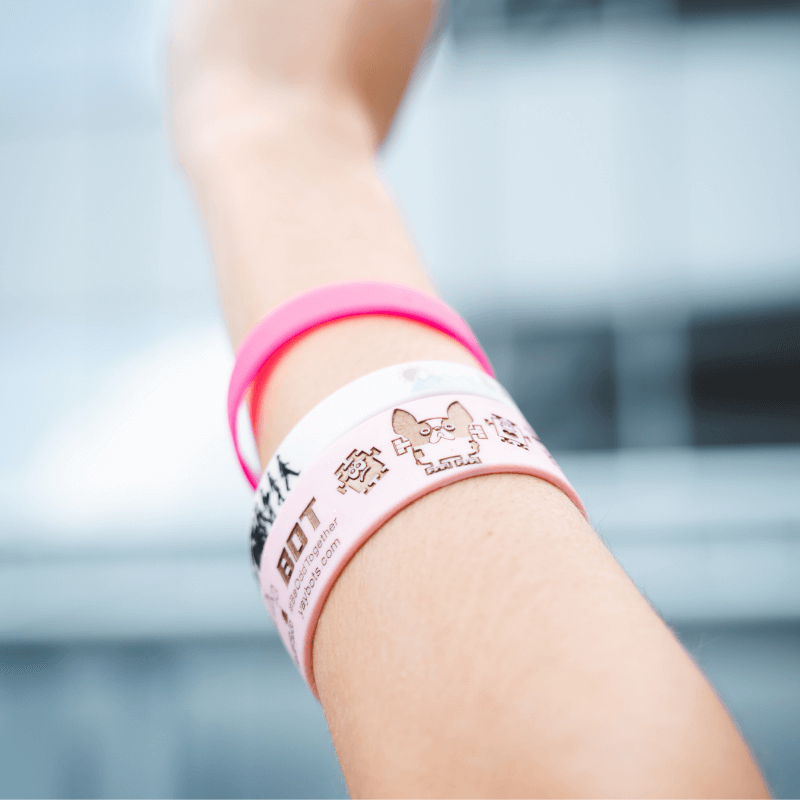
The raised text creates a strong shadow effect, especially in direct light. From a distance, an embossed band reads like an inscribed metal cuff or a stamped leather strap. The letters are physically tactile, which makes the band feel premium when held.
Strengths and limitations of embossed bands
The raised profile is bold, but it does collect dust in the gaps between letters and the edges of the raised artwork can show wear sooner than a flat surface. Embossed is harder to combine with ink-fill because the colour would sit on top of the raised text rather than inside it.
What Is a Debossed Wristband?
A debossed wristband has text and artwork pressed into the silicone, so the design sits below the band surface. This is the most common style sold in Australia and the one most people picture when they think of a custom rubber wristband.
How debossed wristbands are made
The steel mould has the lettering raised on the plate. When silicone is moulded around it, the artwork is pressed into the band, leaving a clean engraved groove. The result is a smooth-profile wristband with crisp recessed text.
What debossed wristbands look like
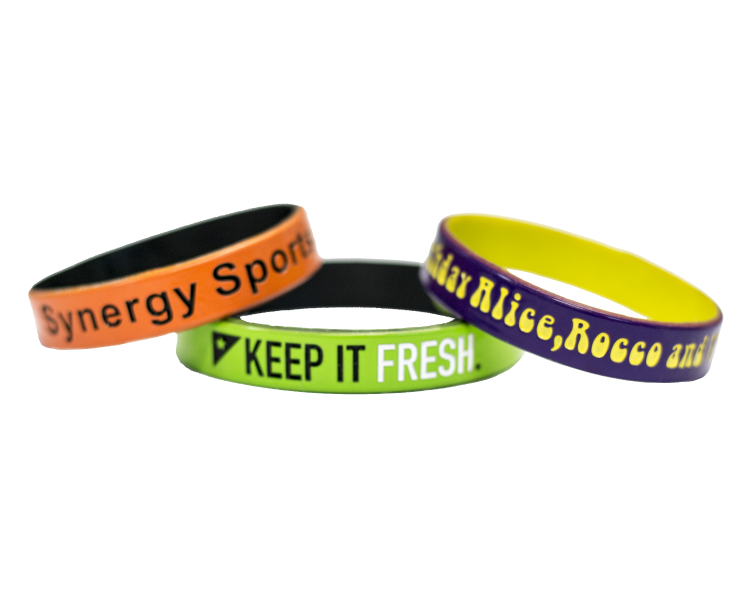
On a single-colour band, the recessed text reads as a clean engraving. When paired with an ink-fill in a contrast colour, the design pops dramatically — the ink sits inside the groove and is protected by the surrounding silicone, which makes it incredibly durable.
Strengths and limitations of debossed bands
Debossed is the industry standard for a reason: it is durable, comfortable to wear, simple to combine with ink-fill, and looks polished even on small skinny bands. The only limitation is that without ink-fill, the contrast can be subtle from a distance.
Pick Your Custom Wristband Style
Debossed, embossed, ink-fill or printed — bands made the way you want them.


Embossed vs Debossed: 7 Side-by-Side Differences
1. Visual impact and shadow
Embossed casts shadows that make the design pop on light bands. Debossed reads cleaner up close, especially when ink-filled with a contrast colour.
2. Comfort and feel
Debossed bands are smoother against the wrist. Embossed bands have a raised bumpy texture that some wearers love and others find scratchy under sleeves.
3. Durability and longevity
Recessed text on a debossed band is protected by the surrounding silicone, so it resists wear from rubbing, washing and sun exposure. Raised embossed text can fade or chip at the edges over time.
4. Cost per unit
Both use moulds, so unit costs are comparable. Embossed often runs 10–15 percent higher because the moulds are less common and order volumes are lower.
5. Ink-fill compatibility
Debossed pairs perfectly with ink-fill — the colour locks into the groove. Embossed cannot use ink-fill in the same way; for colour, you would use colour-coat printing instead.
6. Suitability for small text
Debossed reproduces fine 8–10 point text reliably. Embossed needs slightly bolder letterforms because raised edges can blur on thin strokes.
7. Reorder and consistency
Both styles produce highly consistent batches once the mould is made. Debossed moulds are quicker to retool because they are the industry default.
When to Choose Embossed vs Debossed
Choose embossed when…
- You want a premium tactile feel that wearers can read with their fingers.
- Your campaign is short-term (event giveaway, festival entry, single-day fundraiser) and longevity is not the priority.
- Your artwork is bold, simple block lettering with no fine detail.
- You want the design to read as a 3D stamp from a distance.
Choose debossed when…
- You want a clean engraved look with optional ink-fill for high contrast.
- Wearers will keep the band on long-term (awareness, charity, memorial).
- Your design includes fine text, taglines or a phone number.
- You need maximum durability and a smooth profile under clothing.
Choose ink-fill debossed for awareness campaigns
For cancer awareness, mental health drives and other cause campaigns, ink-fill debossed in a high-contrast colour (white text on yellow for childhood cancer, white on pink for breast cancer, gold on white for mental health) is the gold standard.
Choose colour-coat for a printed look
If you want a fully printed appearance with photographic artwork or multi-colour gradients, neither embossed nor debossed is ideal — use colour-coat printing on a silicone band instead.
Cost, Lead Time and Minimum Quantities
Per-unit cost ranges
- Debossed: from $1.20 each at 1,000+ units, $2.00–$4.00 at 100 units.
- Debossed ink-fill: add $0.20–$0.40 per colour.
- Embossed: comparable to debossed; expect a 10–15 percent premium on small orders.
Production lead times
Standard production is 7–14 business days from artwork approval. Express options can compress this to 5 business days for a fee. Allow extra time for shipping in regional Australia.
Minimum quantities
Our custom debossed wristbands start at just 4 pieces, which is the lowest minimum in the market. Embossed minimums depend on mould availability — typically 100 units.
Adding Colour: Ink-Fill, Colour-Coat and Printing
Ink-fill (debossed only)
Ink-fill applies coloured ink into the recessed groove of a debossed wristband, then wipes the excess from the surface. The result is a long-lasting two-tone look without raising the design.
Colour-coat (works on both styles)
Colour-coat printing paints the entire surface with a contrasting colour, then sands away the high points to expose the base silicone. On embossed bands this gives the raised text a contrast colour. On debossed bands it leaves the design in the original silicone colour.
Screen-printed silicone
Silk-screen printing places ink onto the surface of a blank or debossed band. It is the most flexible option for multi-colour artwork but the ink layer can wear over years of use.
Dual layer and swirl bands
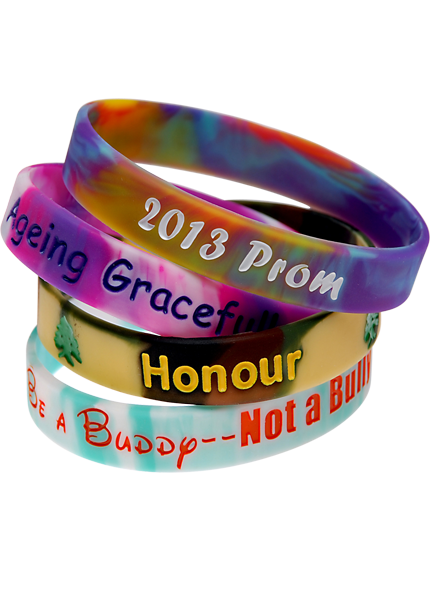
For maximum visual impact, dual-layer wristbands moulded in two colours expose the inner colour wherever the design is debossed through the outer skin — perfect for cause-awareness campaigns.
How to Order Custom Wristbands Step by Step
Step 1: Choose your style and colour
Pick debossed or embossed, then choose a Pantone colour or pick from our standard range. Decide whether you want ink-fill or colour-coat for extra contrast.
Step 2: Submit your artwork
Send a vector file (AI, EPS or SVG) or a high-resolution PNG. Keep text simple — under 35 characters reads best on a standard adult band.
Step 3: Review the proof
Approve a digital mock-up before production starts. Check the spelling, colour codes and quantity carefully — these cannot change once the mould is made.
Step 4: Production and delivery
Production takes 7–14 days. Bands ship in a recyclable bulk pack with a tracking number. Bulk orders can be split-shipped to multiple addresses on request.
Frequently Asked Questions
What is the difference between embossed and debossed wristbands?
Embossed wristbands have raised text that sits above the band surface, while debossed wristbands have recessed text that is pressed into the silicone. Debossed is more common, more durable and works with ink-fill for two-tone designs.
Are embossed or debossed wristbands more durable?
Debossed wristbands are more durable for everyday wear because the recessed text is protected by the surrounding silicone. Embossed text can show edge wear over time, especially with frequent washing or sun exposure.
Can you have colour on embossed wristbands?
Yes — embossed wristbands can be combined with colour-coat printing, which applies a contrast colour layer over the entire band and is then sanded back to expose the silicone on the raised text. They do not work well with ink-fill, which is designed for recessed grooves.
Which is cheaper, embossed or debossed?
Per unit, debossed is usually 10–15 percent cheaper than embossed because the moulds and production process are the industry default in Australia. Both share similar lead times of 7–14 business days.
Do embossed wristbands feel different to wear?
Yes. Embossed bands have a raised, bumpy texture you can read with your fingers. Debossed bands are smooth on the outside, so they slide under shirt sleeves more easily and feel less abrasive against the skin.
What is the minimum order for custom wristbands?
Handband’s custom debossed wristbands start from just 4 units, which is the lowest minimum on the Australian market. Embossed bands typically have a 100-unit minimum because of mould availability.
Which style is best for awareness campaigns?
For cancer, mental health and charity campaigns, debossed with ink-fill is the gold standard — high contrast, long-lasting and instantly recognisable. Yellow with white ink-fill for childhood cancer, pink with white for breast cancer, gold on white for mental health.
Feb 15, 2023

Written by
Founder, Handband
Michael founded Handband to give event organisers, charities, sports clubs, and brand teams a simpler way to source custom wristbands and promotional products. The team has supplied wristbands to festivals, schools, fundraisers, and corporate activations world-wide.

Share on Facebook

Share on X

Share on Pinterest
Comment(s)
Related posts