By Handband Community Team · Handband
Updated 15 May 2026 · 11 min read
Updated 15 May 2026 · 11 min read
Updated May 2026. Wristbands for young children are one of the most versatile parenting and teaching tools available — safety identification at busy events, allergy alerts for food-sensitive kids, emotional regulation aids for ages 4–10, classroom reward systems, and educational tools that turn rote learning into something tactile and fun.
This guide covers every practical use of wristbands for kids ages 1–12: what to print on them, how to size them, when to use which style, and which products work for which use case. Whether you're a parent, teacher, school administrator, scout leader or event organiser, you'll find specific recommendations and ordering guidance below.
Why Use Wristbands for Young Children?
Children are spontaneous, easily distracted, and unable to recall complex information under stress. A wristband solves the "what do I do if I get lost" problem with a 2-second glance — kids who can't yet recite phone numbers can show their wrist to a stranger or staff member. Beyond safety, wristbands serve as low-cost classroom tools, behaviour reinforcement, and emotional regulation aids.
Real-world use cases for kids' wristbands
- Crowded events (festivals, theme parks, school excursions, family weddings)
- Allergy and medical identification (peanut, dairy, asthma, epilepsy)
- Classroom learning (multiplication, sight words, sequencing)
- Emotional regulation (mood-indicator emotion bracelets)
- School reward systems (house colours, achievement levels, kindness awards)
- Sports teams and groups (team identification, age-group bands at carnivals)
- Sensory aids (chewable bands for ASD/ADHD self-regulation)
Safety Wristbands for Kids at Events
The most common use: a wristband with parent contact details for children at large public events. If your child gets separated, a staff member or stranger can read the band and call you immediately.
What to print on a kid's safety wristband
- Parent first name + mobile number (most important)
- Backup contact: grandparent, partner
- Major medical conditions or allergies
- Venue or hotel name (for holidays)
- Optional: "Lost? Please call" lead-in
Which style works best for safety bands?
Custom debossed silicone — durable, waterproof, comfortable for full-day wear, won't tear off. Cheaper than printed Tyvek for repeat use across multiple events.
Tyvek paper wristbands — single-use option for one-off events. Cheap, tamper-resistant, but won't survive multi-day wear.
Recommended for you
Products related to this article
Hand-picked to go with what you just read.
Allergy and Medical Alert Bands for Children
According to ASCIA, 1 in 10 Australian infants and 4–8 percent of school-age children have a food allergy — many severe enough to cause anaphylaxis. A bright-coloured allergy alert band lets teachers, carers and other parents recognise the risk instantly.
Common allergy band colours and meanings
- Red — severe allergy / anaphylaxis risk
- Orange — peanut and tree nut allergy
- Yellow — dairy or egg allergy
- Green — gluten / coeliac
- Blue — asthma
What to print on a child's medical band
Allergen name (NUT ALLERGY / EGG ALLERGY), severity flag (EpiPen carrier / Anaphylaxis), and parent contact. Keep wording short and high-contrast (white on red, white on orange).
Emotion Bracelets for Kids
Emotion bracelets help children identify and communicate their feelings non-verbally. The band has different colours or sliding segments — the child indicates their mood by rotating the band or pointing to the colour matching how they feel.
How emotion bands are used
- In the classroom: teacher checks emotion bands during morning circle — identifies kids needing extra support that day
- In therapy: pediatric psychologists use them to help kids ages 4–10 develop emotional vocabulary
- At home: parents check emotion band when a child seems off but won't talk
- For ASD/ADHD: helps neurodivergent kids communicate feelings they may struggle to verbalise
Colour-feeling associations (typical mapping)
- Green – happy, calm, ready
- Yellow – nervous, frustrated
- Red – angry, upset
- Blue – sad, tired
- Purple – overwhelmed, anxious
Educational Wristbands for Learning
Kinesthetic learning aids — tools kids touch and manipulate — improve retention 15–25 percent vs flat printed sheets. Educational wristbands turn rote learning (times tables, sight words, number sequences) into wearable, tactile tools.
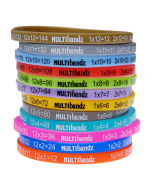
Multibandz — number sequences and counting
Multibandz are stacked silicone bands printed with number sequences (1–10, 1–100, skip counting by 2s, 5s, 10s). Kids slide the bands around their wrist while practising. Used in early childhood (preschool to year 2) for foundational number sense.
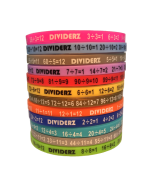
Dividerz — multiplication and division tables
Dividerz are wristbands printed with times tables (2x, 3x, 5x, 10x). Years 3–6 students wear them through the term and refer to them as needed. Builds fluency without flashcard fatigue.
Sight word and spelling bands
Custom bands printed with the week's spelling list or high-frequency sight words. Each student wears their own list. Read-aloud practice happens spontaneously throughout the day.
Languages and second-language vocab
Custom-printed bands with daily target vocabulary in the second language. Particularly effective in Auslan, Italian, Mandarin and Japanese language programs.
School Reward and House Wristbands
House colour bands for sports carnivals
Distribute house-colour wristbands at the start of carnival day. Red house = red bands, Blue house = blue, etc. Kids feel team unity from band-on moment; teachers identify house at a glance for scoring.
Achievement bands
Earn a band by meeting a goal: reading 10 books (Reading Star band), attending 90 percent of term (Attendance band), demonstrating kindness (Kindness Award band). Worn with pride, builds intrinsic motivation.
Level-up bands (Bronze, Silver, Gold)
Three-tier system where kids start Bronze and earn Silver, then Gold through demonstrated behaviour or academic milestones. Visible progress + collectible appeal drives engagement.
Custom event bands
School fete, sports day, swimming carnival, end-of-year concert — each event gets its own custom band. Builds tradition and gives kids a tangible memento. See our school fair planning guide for the full event playbook.
Slap Bands and Sensory Bands for Active Kids
Custom printed slap bands
Slap bands are flat bands kids slap onto their wrist where they curl into shape. The novelty makes them kid-favourites for party favours, classroom rewards and birthday loot bags. Available with custom solid or striped printed designs.
Chewable / fidget bands for ASD and ADHD
Some kids with autism spectrum disorder or ADHD benefit from a chewable wristband as a self-regulation tool — replacing destructive chewing of clothing, hair or pencils. Choose food-grade silicone bands designed for chewing.
Glow-in-the-dark bands for night events
Phosphorus-pigment silicone bands charge under UV light and glow for 4–6 hours. Perfect for night parties, sleepovers, end-of-school discos, Halloween events.
What Age to Start Using Wristbands?
Age 1–3 (toddlers)
Use Toddler size (140 mm). Supervise wear. Best uses: parent contact bands at busy events, allergy alert bands. Avoid loose bands that could be removed and put in mouth.
Age 4–7 (preschool / early primary)
Use Kids size (165 mm). Best uses: emotion bracelets, learning bands (number sequences), house-colour bands for sports day, safety bands for school excursions.
Age 8–12 (mid-primary)
Use Kids or Youth size (165–180 mm). Best uses: educational bands (multiplication, sight words), achievement bands, house carnival bands, friendship bands, charity/awareness bands.
How to Buy Kids Wristbands in Bulk
For schools and parent groups
Order 100–500 units per design in Kids or Youth size. Bulk pricing at 100+ units brings cost to under $2 per band. Design with your school logo + house colour + year level for maximum reuse across events.
For event organisers
Order 500–2,000 units in Tyvek for single-use events (sports tournaments, school fetes). Tyvek bands cost a fraction of silicone and serve as one-day access control + emergency contact in one band.
For parents (individual safety bands)
Order 4–10 custom-debossed silicone safety bands in toddler/kids size for family holidays, theme parks, beach trips and family weddings. Rotate bands across multiple kids in the family with the same parent contact details.
References & Further Reading
- ASCIA (Australasian Society of Clinical Immunology and Allergy) — Food Allergy in Children Statistics 2024.
- Australian Department of Education — Wellbeing Tools for Primary Classrooms.
- Raising Children Network — Identification Bracelets for Kids at Public Events.
- Autism Awareness Australia — Sensory Self-Regulation Tools for ASD Kids.
- Hattie, J. (2009). Visible Learning: kinesthetic learning effect sizes. Routledge.
Frequently Asked Questions
Quick answers from the Handband team
Are wristbands safe for young children?
Yes — medical-grade silicone wristbands are safe for ages 1+. They are hypoallergenic, latex-free, and contain no BPA or phthalates. For toddlers under age 3, supervise wear (no swallowing risk for properly fitted bands) and choose kid or toddler sizing rather than adult bands.
What size wristband fits a young child?
Toddler size (5.5 inch / 140 mm circumference) fits ages 1–4. Kids size (6.5 inch / 165 mm) fits ages 5–10. Youth size (7 inch / 180 mm) fits ages 11–15. Measure your child's wrist with a flexible tape — round up to the next size for comfort and growth room.
What information should I put on a child's safety wristband?
Essential: parent name + mobile number, child's medical conditions (allergies, asthma, epilepsy, diabetes), emergency contact, and the venue/event name. Optional: 'Lost? Please call...' line, blood type, school name. Keep wording short — under 35 characters reads clearly on a kid-sized band.
How are emotion bracelets for children used?
Emotion bracelets help kids identify and communicate their feelings non-verbally. The child turns the band or points to a colour matching their current mood (e.g. green = happy, yellow = nervous, red = angry). Used in classrooms, therapy and at home to build emotional vocabulary in ages 4–10.
Can wristbands help children learn?
Yes — educational wristbands like Multibandz (number sequences) and Dividerz (multiplication tables) make rote learning interactive and tactile. Kids wear them and refer to the printed information throughout the day. Studies show kinesthetic learning aids (like wearable maths) improve retention 15–25 percent vs flat printed sheets.
How do schools use kids wristbands for behaviour and reward?
Schools use coloured wristbands to recognise good behaviour, attendance, classroom contribution and house spirit. Each colour represents a level (Bronze, Silver, Gold) or specific achievement (Kindness Award, Reading Star). Kids earn bands and wear them with pride. Cost is under $1 per band when ordered in bulk.
Are wristbands a choking hazard for toddlers?
Properly sized silicone wristbands are not a choking hazard — they fit snugly on the wrist and cannot be removed or torn by toddlers. Avoid loose-fitting adult bands on small children. Tyvek paper bands with adhesive closure are also safe and tear-resistant for short events.
Ready to order? See our custom kids wristbands \xe2\x80\x94 youth sizes, school-friendly and printed with your design.

Written by
Founder, Handband
Founder of Handband; specialist in custom wristbands and promotional products for events, schools, charities, and brands.
← Previous
10 Study Tips to Help You Hit Your Goals: How Wristbands and Smart Habits Boost Student Success
Next →
How to Organise a Sports Tournament: Planning, Wristbands, and Team Management Tips
Comment(s)