By Handband Community Team · Handband
Updated 12 May 2026 · 13 min read
Updated 12 May 2026 · 13 min read
Updated May 2026. Custom wristbands look simple from a distance, but there are at least eight different printing methods used to put your design onto the band — each with different production costs, durability, visual results and minimum order quantities. This guide walks through every method, with examples, pricing ranges and recommendations on which to choose for your event or campaign.
Whether you're ordering 4 bands for a small family fundraiser or 50,000 for a multi-day festival, knowing the print method makes the difference between a band that lasts 6 months and one that lasts 6 years.
Quick Reference: 8 Wristband Print Methods
- Debossed — design pressed INTO the silicone (recessed text). Industry standard.
- Embossed — design RAISED above the silicone surface.
- Ink-fill — coloured ink filled INSIDE debossed grooves for high contrast.
- Colour-coat — full-surface contrast colour painted then sanded back to expose the design.
- Screen-print (silk-screen) — multi-colour ink applied to the band surface.
- Laser cut / dual-layer — two coloured layers, laser cuts through the outer to expose the inner colour.
- Dye-sublimation — full-colour photo printing on fabric or tyvek bands.
- Pad printing — ink pad transfers spot designs onto band surface.
1. Debossed Wristbands (Industry Standard)
How debossed printing works
A steel mould has the design raised on the plate. When liquid silicone is poured in and cured, it's pressed around the raised design — leaving the text and artwork recessed (pressed into) the finished band. No ink, no surface coating — the design is part of the silicone itself.
What debossed wristbands look like
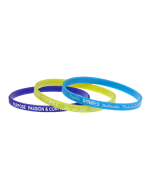
Single-colour bands with engraved-style text. Reads clean and professional up close. Without ink-fill, the contrast is subtle — readable from a metre away. With ink-fill, the design pops dramatically.
Cost and lead time
From $1.20 per band at 1,000+ units, $2.50 at 100 units, $5 at 4–10 units. Standard production 7–14 business days. The most affordable and fastest custom method.
Best for
Awareness campaigns, fundraisers, charity walks, corporate giveaways, school events. Anywhere you need long-lasting custom branding at the lowest cost per band.
Recommended for you
Products related to this article
Hand-picked to go with what you just read.
2. Embossed Wristbands (Premium Tactile)
How embossed printing works
The opposite of debossed — the mould has the lettering recessed into the plate. Silicone fills the recesses, so the finished band has raised text and artwork protruding from the surface.
What embossed wristbands look like
Tactile, 3D feel. Raised letters cast shadows in light, giving a premium stamped look. Wearers can read the text with their fingertips.
Cost and lead time
Comparable to debossed — expect a 10–15 percent premium because the moulds are less common and order volumes are lower. Same 7–14 day production.
Best for
Premium events where the tactile experience matters: brand launches, executive VIP giveaways, fashion-themed events. Less suitable for long-term wear (raised edges can show wear).
3. Ink-Fill Wristbands (Debossed + Colour)
How ink-fill works
Start with a debossed band. Coloured ink is squeegeed across the surface, filling the recessed grooves. Excess is wiped off the high surface. The ink sits inside the groove, protected by the surrounding silicone — durable for 3–5 years.
Colour combinations
White ink on yellow (childhood cancer), white on pink (breast cancer), gold on white (mental health), black on white (corporate), white on red (warning/safety). Any contrast combination available.
Cost
Add $0.20–$0.40 per colour to the base debossed price. Most orders use 1–2 ink colours.
4. Colour-Coat Printing (Full-Surface Contrast)
How colour-coat works
A contrasting colour layer (typically white, black or metallic) is painted across the entire band surface. The high points are then sanded back to expose the base silicone — revealing the design in the original silicone colour while the recessed/raised areas hold the contrast coat.
Result
Bold 2-tone bands with the design in one colour and background in another. Strong visual impact, very durable (2–4 years).
Cost
Add $0.30–$0.50 per band over base debossed/embossed price.
Best for
Brand activations, sponsorship deals, high-visibility events.
5. Screen Printing (Multi-Colour Spot Designs)
How silk-screen printing works
Ink is pushed through a fine mesh stencil onto the band surface. One screen per ink colour — multi-colour designs require multiple passes. Works on blank or debossed silicone bands.
Multi-colour capability
Supports 1–6 spot colours. Ideal for sponsor logos, multi-colour brand designs, gradient effects (with halftone stippling).
Durability
1–2 years of daily wear before surface ink shows visible wear. Best for short-to-medium campaigns rather than long-term promotional bands.
Cost
$0.40–$0.80 per band depending on colour count and minimum order. Setup fees apply for each new design.
6. Laser Cut / Dual-Layer Wristbands
How dual-layer laser cutting works
Two silicone layers moulded together — typically a coloured outer skin over a contrasting inner colour. A laser cuts through the outer layer wherever the design appears, revealing the inner colour beneath.
Result
Striking 2-tone bands where the design is the base silicone colour itself (not surface ink). Permanent — the colour cannot fade or wear off because it's embedded in the band structure.
Cost
Premium — 2–3× the cost of standard debossed. Worth it for high-end cause campaigns and brand activations.
Best for
Memorial bands, cause awareness, premium corporate giveaways, anywhere durability + visual impact justify the cost.
7. Dye-Sublimation Printing (Photo-Quality on Fabric)
How dye-sub works
Dye-sublimation uses heat to transfer full-colour artwork from a transfer paper into the fabric fibres of the band. Used on woven/printed fabric wristbands and synthetic Yupo wristbands — not on silicone.
Result
True photo-quality printing: gradients, photographic logos, complex artwork, multiple colours per band. Print becomes part of the fabric fibre, so it doesn't crack, peel or wash off.
Cost
$0.50–$1.50 per band for fabric. Most expensive print method per unit but supports the most complex artwork.
Best for
Music festivals, concerts, premium event wristbands. See our fabric wristbands range.
8. Pad Printing (Spot Designs)
How pad printing works
An ink pad picks up the design from an engraved plate and transfers it onto the band surface in one press. Used for small spot logos on hard surfaces and select silicone applications.
Best for
Small spot logos, mascot icons, simple repeated designs. Less common than the methods above — ask if it suits your use case.
Which Print Method Should You Choose?
If your budget is tight
Debossed without ink-fill. Cheapest method, lasts forever, looks clean.
If you want maximum visual impact
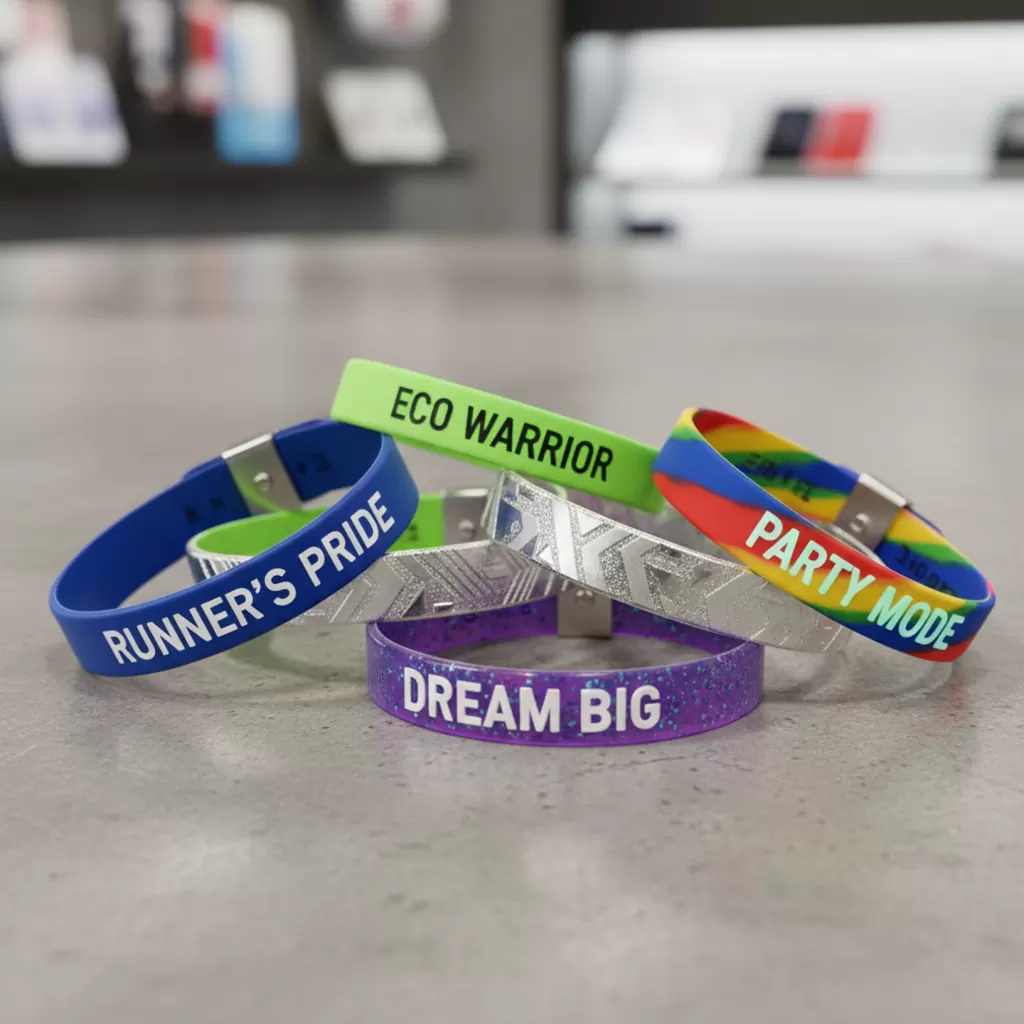
Debossed + ink-fill or colour-coat printed. Both produce 2-tone bands that pop on the wrist.
If you need full-colour artwork or photos
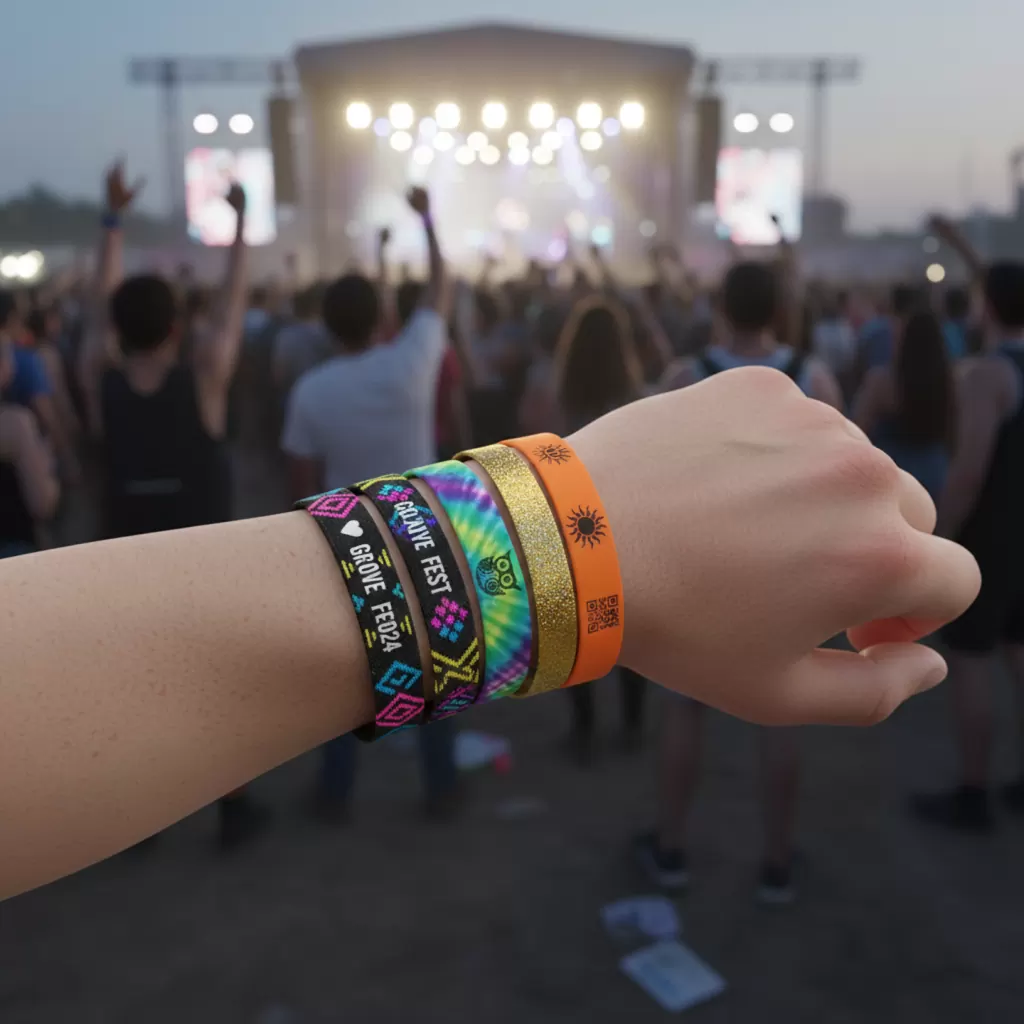
Dye-sublimation on fabric/tyvek bands. Best for festival and concert wristbands.
If you need premium long-lasting bands
Dual-layer laser. Permanent colour, premium feel, durable for years.
If you want a tactile 3D feel
Embossed. Raised text that wearers can feel.
If you need multi-colour spot designs (sponsor logos)
Screen printing. Up to 6 spot colours per band.
Print Method Cost Comparison (per band, AUD)
- Debossed: $1.20–$5.00 (volume-dependent)
- Debossed + ink-fill: add $0.20–$0.40 per colour
- Embossed: 10–15 percent premium over debossed
- Colour-coat: add $0.30–$0.50 to base
- Screen-print: $0.40–$0.80 per colour
- Dual-layer laser: 2–3× base debossed cost
- Dye-sublimation (fabric): $0.50–$1.50
- Tyvek paper printing: $0.10–$0.30
Print Quality Affecting Factors
Artwork format and resolution
Vector files (AI, EPS, SVG) reproduce sharpest. Raster files (PNG, JPG) need at least 300 DPI at print size. Text smaller than 8 point becomes unreadable on most methods.
Colour matching
Specify Pantone colours for brand-exact reproduction. Without Pantone, your supplier will match to the closest standard colour, which can vary 10–15 percent in tone.
Band width vs design complexity
Skinny (6 mm) bands suit short text only. Standard (12 mm) suits one line of text plus a small icon. PHAT (25 mm) bands support multi-line text and detailed logos.
Related Reading
- Embossed vs Debossed Wristbands: Differences, Pros, Cons & When to Use Each
- How to Clean Silicone Wristbands: 6 Easy Methods
- How to Shrink Silicone or Rubber Bracelets: 3 Quick Methods
- Wristband Colour Meanings: Mental Health, Cancer & 30+ Cause Colours
References & Further Reading
- Promotional Products Association International (2024) — Wristband Industry Cost Benchmarks Report.
- Society of Plastics Engineers (2023) — Silicone Moulding and Surface Decoration Techniques.
- DuPont Tyvek — Print Methods Compatibility Guide for Synthetic Paper Wristbands.
- Pantone Inc. — Colour Matching System: PMS Guide for Custom Manufacturing.
- FESPA (Federation of European Screen Printers Associations) — Screen Printing on Curved Surfaces Best Practices.
Frequently Asked Questions
Quick answers from the Handband team
What is the difference between debossed and embossed wristbands?
Debossed wristbands have the design pressed INTO the silicone (recessed text), while embossed wristbands have the design RAISED above the surface. Debossed is the more common style — it's smoother on the wrist and pairs perfectly with ink-fill. See our full comparison at /au/blog/whats-the-difference-between-embossed-and-debossed-wristbands/.
What is ink-fill on a wristband?
Ink-fill is a contrast-colour ink applied INSIDE a debossed groove, then wiped off the surface. The colour sits inside the recessed text, protected from wear. Most popular combo: yellow band with white ink-fill (childhood cancer awareness) or black band with white ink-fill (corporate).
What is colour-coat printing on a wristband?
Colour-coat printing applies a contrasting colour layer over the entire band surface, then sands the high points back to expose the base silicone. The result is a 2-tone band with the design in one colour and background in another. Works on both debossed and embossed styles.
Can you screen-print a silicone wristband?
Yes — silk-screen printing applies ink to the surface of a blank or debossed band. It supports multi-colour artwork that other methods can't reproduce. The trade-off: surface ink can wear over years of daily use. Best for events and short-to-medium campaigns.
How long does each print method last on a wristband?
Debossed text: lifetime (it's part of the band itself). Ink-fill: 3–5 years before fading. Colour-coat: 2–4 years. Screen-print: 1–2 years of daily wear. Laser-cut dual-layer: lifetime (colour is the base layer itself).
Which wristband print method is cheapest?
Debossed (without ink-fill) is the cheapest custom method — from $1.20 per unit at 1,000+ units. Adding ink-fill costs $0.20–$0.40 per colour. Colour-coat and screen-print add $0.30–$0.50 per band. Tyvek paper printing is cheapest overall (under $0.30 each).
Can you print full-colour photos on a wristband?
Yes, with limitations. Dye-sublimation printing on fabric/tyvek bands supports full-colour photo artwork. Silicone bands need either screen printing (multi-colour spot designs) or colour-coat (2-tone). True photo-print silicone is rare and expensive.
Can you print on wristbands?
Yes. Silicone wristbands can be debossed, embossed, ink-filled, colour-coated, screen-printed or laser-cut; fabric and Tyvek bands take full-colour dye-sublimation printing. The right method depends on your budget, durability needs and artwork detail.
Ready to print your own wristbands?
Order custom debossed wristbands, browse the full silicone wristband range, or print Tyvek event wristbands. Send your artwork and we will quote it — lead time depends on quantity, typically 10–14 business days, quicker on application.

Written by
Founder, Handband
Founder of Handband; specialist in custom wristbands and promotional products for events, schools, charities, and brands.
← Previous
Best Wristbands for Sensory Issues: Comfortable, Safe Options for Autism and Sensory Sensitivities
Next →
How Strong Are Silicone Wristbands? Durability, Tear Resistance, and Longevity Explained
Comment(s)