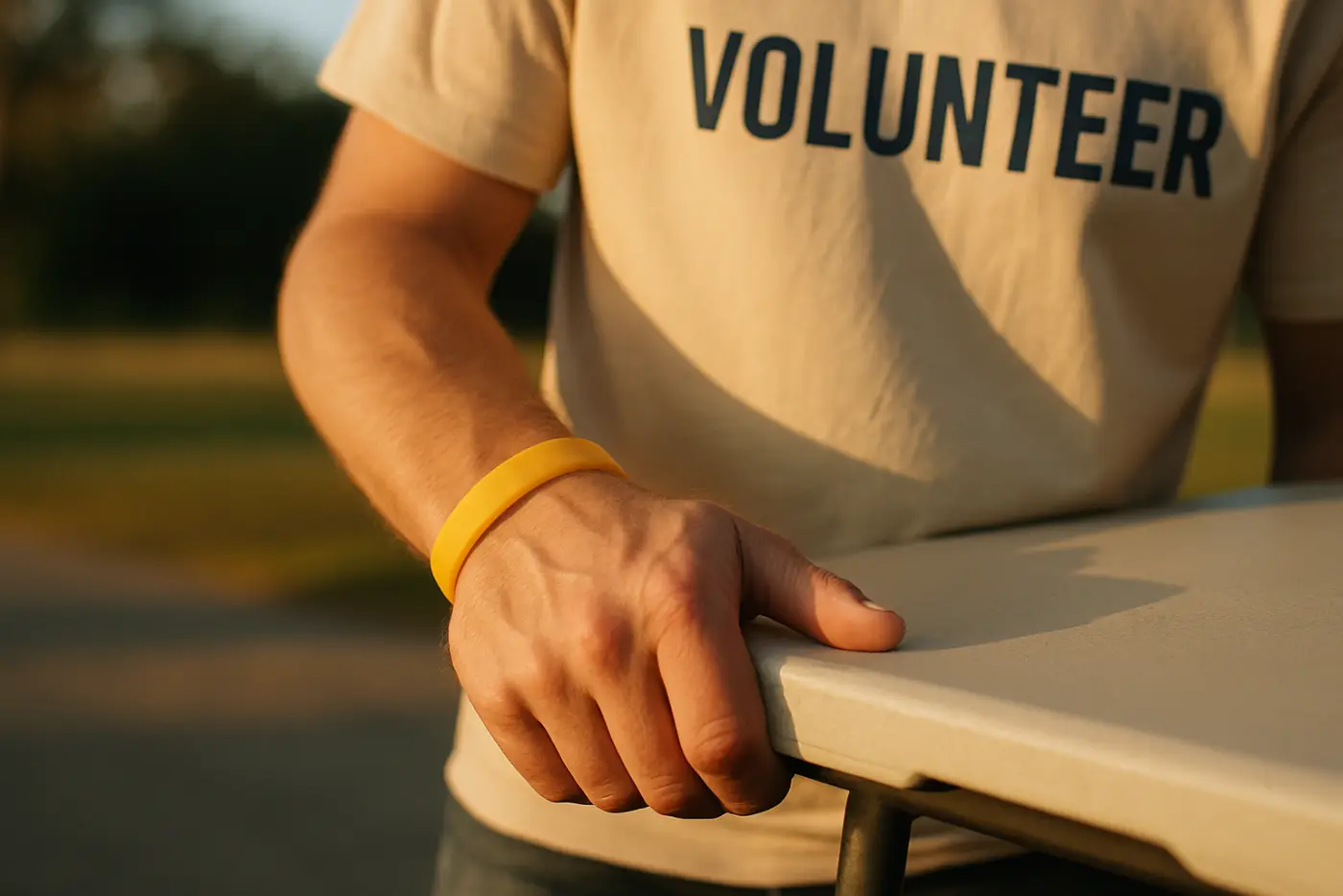
On a busy event day the public need to be able to spot someone official, and the coordinator needs to see at a glance which team a person belongs to. A volunteer wristband does both jobs cheaply, and unlike a vest or a lanyard it stays on through set-up, a shift and pack-down without being taken off and left on a table.
Volunteers need to be findable by the public
Most attendee questions go to whoever looks official. If your volunteers are indistinguishable from the crowd, those questions land on the two people wearing high-vis and the queue at the info tent gets longer. A consistent, visible band makes every volunteer a point of contact.
One colour per team, not per person
Resist the urge to make everything bespoke. Colour by function — gates, parking, food, first aid, set-up — so a coordinator standing in the middle of a field can see whether the marshalling team is where it should be. Names and shifts go on the roster, not the band.
Recommended for you
Products related to this article
Hand-picked to go with what you just read.
Print the essentials, keep it simple
A two-colour print is enough for an event name and the word "volunteer", and it costs a fraction of a full-colour run. A two-colour printed band is the practical middle ground between a plain colour and an expensive full-colour design nobody looks at closely.
Give the band enough surface to be seen
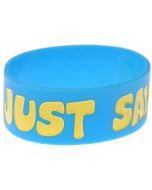
A thin band at ten metres is invisible. If the point is public recognition, use a wider band that carries the wording legibly across a field. A wide solid band reads from further away, which matters more than the artwork detail.
Make it easy to put on and take off between shifts
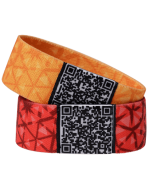
Volunteers rotate, and the same person may cover two teams in a weekend. A stretch fabric band goes on and off without a fastener, which suits multi-shift rosters where a locked band would need cutting and replacing.
Order spares and hand them out at sign-in
Volunteer numbers move right up to the morning of the event — people drop out, friends get recruited on the day. Issue bands at sign-in rather than posting them in advance, and hold a generous surplus so nobody who turns up to help ends up unidentifiable.
Frequently Asked Questions
Quick answers from the Handband team
Why do volunteers need wristbands?
So the public can identify who to ask, and coordinators can see which team someone belongs to across a crowded site.
Should bands be colour-coded per person or per team?
Per team — gates, parking, food, first aid. Names and shift times belong on the roster, not on the band.
Is a full-colour print worth it?
Usually not. A two-colour print carrying the event name and the word volunteer costs far less and reads just as well.
Why does band width matter?
Because recognition happens at distance. A wider band carries legible wording across a field; a thin one is invisible at ten metres.
What suits volunteers working multiple shifts?
A stretch fabric band that goes on and off without a fastener, rather than a locked band that has to be cut and replaced.
When should bands be handed out?
At sign-in on the day. Volunteer numbers change right up to the morning, so posting them in advance wastes stock.
How many spares should we order?
A generous surplus. Someone always recruits a friend on the day, and an unidentifiable helper is worse than an unused band.

Written by
Founder, Handband
Founder of Handband; specialist in custom wristbands and promotional products for events, schools, charities, and brands.
← Previous
Mourners bid farewell to Sask. crash victims
Next →
Colour-Coded Wristbands for Organising Groups & Events
Comment(s)