
RFID and NFC Wristbands for Events: Cashless Payments and Access Control

Designed in Sydney since 2004 · 4.9★ verified customer rating · Cashless, access & data on one band
Quick answer
An RFID wristband (or NFC wristband) is an event band with a small chip inside it. Attendees tap to pay at the bar, tap to enter a gate or zone, and the chip captures the data you need for crowd flow and stock. The chip can sit in a woven fabric band (tamper-evident, locked on at the gate) or a silicone band (reusable and comfortable, but not tamper-evident). The right chip depends on your payment or access platform — we break the chip types down below. Lead time depends on quantity and the chip — typically 10–14 business days, larger runs and some chips longer, quicker on application.
RFID and NFC wristbands turn an event band into a wallet and a key. Instead of cash, lanyards and ticket scanning at every point, each attendee wears one band that pays, opens gates and tells you what is happening across the site in real time.
This guide explains how RFID event wristbands work, the chip types and what each is for, the difference between RFID and NFC, how they handle cashless payments and access control, whether to put the chip in silicone or fabric, and how to spec and order them for a festival, conference or activation in Australia.
How do RFID and NFC wristbands work?
An RFID wristband has a tiny chip and antenna sealed inside the band. When the wristband passes close to a reader — at a bar, a gate or a zone entrance — the reader powers the chip and reads its unique ID. That ID is linked to the attendee’s account, so a single tap can take a payment, check a ticket or log a movement. There is no battery in the band and nothing for the attendee to charge.
NFC (near-field communication) is a short-range form of RFID that works at a few centimetres on the 13.56 MHz high-frequency band — the same technology behind contactless cards and phone payments. UHF RFID has a longer read range, which suits fast-moving gates and crowd scanning. Most event programmes use a mix — and which chip does which job is the question we get asked most.
Which chip do you need? RFID and NFC chip types explained
There is no single “RFID chip” — there is a family of them, and the right one depends on what the band has to do and which platform you are running. The simplest rule: match the chip to your cashless or access platform. Most platforms specify the chip they support; tell us the platform and we match it. Here is what each common chip type is for.
| Chip | Type | Best for |
|---|---|---|
| NTAG213 / 215 / 216 | NFC (phone-readable) | Tap-to-link with a phone: web pages, social follows, promos, digital content, light check-ins. NTAG215 is the most widely compatible. |
| MIFARE Classic 1K / 4K | NFC (HF) | The festival workhorse — closed-loop cashless and access on most event platforms. |
| MIFARE Ultralight / EV1 | NFC (HF), low-cost | Single-use or short-run entry tickets and gate access where cost-per-band matters. |
| MIFARE DESFire EV2 / EV3 | NFC (HF), encrypted | Secure cashless payments and high-value or sensitive access; one chip can run several applications. |
| UHF (Impinj / UCODE) | UHF, long-range | Reads up to about a metre and scans many bands fast — high-throughput gates, zone scanning, crowd-flow analytics. Not phone-readable, not for tap-to-pay. |
Rule of thumb: NFC (NTAG or MIFARE) for tapping — payments, access and phone interactions; UHF for reading lots of bands quickly at distance — gates and crowd analytics. Unsure? Send your platform and we match the chip to it.
What can an RFID event wristband do?
| Use | What it does |
|---|---|
| Cashless payments | Attendees top up a balance and tap to pay at bars, food and merch. Queues move faster and you cut cash handling. |
| Access control | Tap to enter the gate, a VIP area, backstage or a multi-day re-entry lane. One band, the right permissions. |
| Zone scanning | Read attendees in and out of stages or zones to manage capacity and crowd flow on the day. |
| Data capture | Spend, dwell time and traffic by zone, so you can plan bars, staffing and next year’s site map from real numbers. |
| Phone interactions | With an NFC tag, a tap opens a web page, social follow or promo — useful for sponsor lead capture and brand activations. |
RFID wristbands for access control
Access control is the other half of what these bands do. A single tap at the gate reads the chip, checks the attendee’s permissions and opens — or turns them away. Because the permissions live against the ID, one band can hold several access rights at once: general admission, a VIP or backstage zone, an artist or crew accreditation, and a multi-day re-entry pass. You decide who can go where, and the readers enforce it at speed.
For paid entry you want a tamper-evident woven fabric band locked on at the gate, so the pass cannot be slipped off and handed on. For staff, crew and contractor accreditation a reusable silicone band is often the better fit. Long-range UHF chips suit high-throughput gates where a queue has to keep moving; NFC (MIFARE) suits controlled points such as a backstage door or a members’ lounge. Every tap is logged, so you also get a live count of who is on site and in each zone — useful for capacity limits and safety.
Silicone or fabric: which band carries the chip?
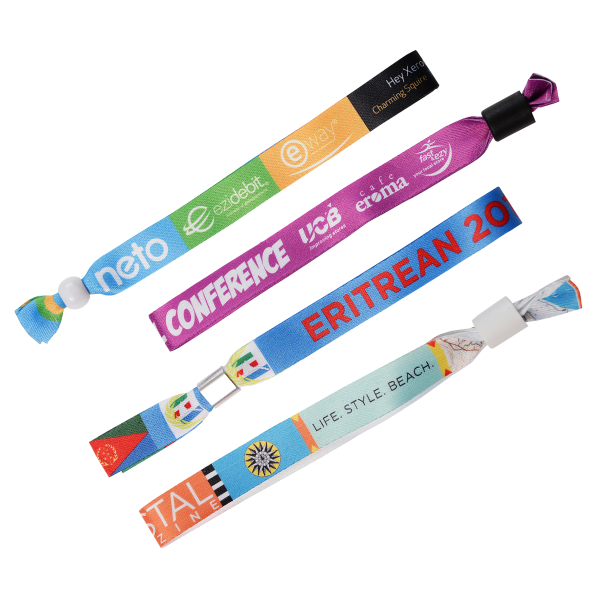
The chip is an inlay, so it can go into more than one band type. The two we use most for events are woven fabric and silicone — and the choice matters, because they behave differently once they are on the wrist.
| Band | Tamper-evident? | Best for |
|---|---|---|
| Woven fabric (barrel lock) | Yes — locked on at the gate, cannot be removed and passed on. | Paid entry, general admission, single-fit multi-day wear — anywhere the band must not transfer. |
| Silicone | No — slips on and off, so it is reusable but transferable. | Staff and crew, members, season passes, multi-event reuse, VIP keepsakes. Low minimum of 4 per design. |
Use fabric where the band must stay put and can’t be passed on — that is most paid-entry events. Use silicone where you want a comfortable, reusable band and transfer is not a risk, such as staff access or a returning membership. Tyvek can also carry a low-cost inlay for short, disposable runs.
Choosing RFID wristbands for your event
Once the chip and band are settled, a few decisions shape the rest of the spec: single-day or multi-day re-entry, whether you need VIP and artist tiers, whether the chip drives cashless payments, access control or both, how top-ups and POS points are set up, and which payment or access platform you are running. Bring your platform and we will match the chip and encoding to it, then weave your event artwork and palette into the band. If you are still shortlisting suppliers, our guide to choosing a custom wristband supplier covers what to check before you commit.
View woven fabric event wristbands →
How much do RFID wristbands cost?
RFID event wristbands are priced per band and depend on the quantity, the band material and finish, and the chip your platform needs — a low-cost NFC tag costs less than a secure DESFire or a long-range UHF chip. They sit above a plain printed band because of the embedded chip, and the per-band price falls as the run gets larger, so festival-scale orders are the most cost-effective.
Fabric bands run at higher minimums than our silicone range, where the minimum is four per design — handy for a small reusable batch of RFID staff or VIP bands. The fastest way to a firm number is to send your quantity, dates, the platform and what you need the chip to do, and we will quote it. Lead time depends on quantity and the chip: a typical run is 10–14 business days, larger runs and certain chips take longer to source and encode, and quicker turnarounds are available on application.
Get a quote for RFID event wristbands →
RFID event wristband questions
How do RFID wristbands work for events?
A chip and antenna are sealed inside the band. When the wristband passes a reader at a bar, gate or zone, the reader powers the chip and reads its unique ID, which is linked to the attendee’s account. A single tap can take a payment, check entry or log a movement. There is no battery in the band and nothing to charge.
What chip do I need for my event?
Match the chip to your platform. As a guide: NTAG213/215/216 for phone taps (links, social, promos); MIFARE Classic for standard closed-loop cashless and access; MIFARE Ultralight for low-cost single-use entry; MIFARE DESFire for secure cashless and high-value access; and UHF (Impinj or UCODE) for long-range, high-throughput gates and crowd-flow scanning. Most cashless and access platforms specify the chip they support — tell us the platform and we match it.
Are RFID wristbands waterproof?
The chip is sealed inside the band, so it keeps working through rain, splashes, sweat and hand-washing — which is what a multi-day outdoor festival needs. Silicone bands are fully water-resistant, and woven fabric and Tyvek handle normal event wear and wet weather. None of them should be a problem for a standard event; tell us if the bands will be fully submerged so we can advise.
How are RFID wristbands programmed?
Each chip carries a unique ID. We can pre-encode the bands before dispatch, or your cashless or access platform can encode them and link each ID to an attendee account at check-in or top-up. For most closed-loop systems the platform does the live encoding on site; we supply the bands with the right chip and any pre-encoding you need. Send your platform and we will confirm what has to be encoded before the event and what happens on the day.
Can the chip go in a silicone wristband, or only fabric?
Both. The chip is an inlay, so it can sit in a woven fabric band, a silicone band or a Tyvek band. The trade-off is tamper-evidence: a fabric band has a barrel lock and cannot be removed once it is fitted, while a silicone band slips on and off, so it is reusable but transferable. Use fabric for paid entry, silicone for staff, members or reusable bands.
Are silicone RFID wristbands tamper-evident?
No. Silicone bands slip on and off, so they are not tamper-evident and can be passed between people — which is fine for staff, crew, members or reusable bands, but not for paid entry. Where the band must not transfer, use a woven fabric band with a barrel-lock closure, fitted at the gate.
How long do custom RFID wristbands take to make?
Lead time depends on quantity and the chip. A typical run is around 10–14 business days; larger runs and certain chips take longer to source and encode, and quicker turnarounds are available on application. Send your dates with the brief and we will confirm timing against your quantity and chip.
Related reading
- The complete guide to wristbands for events
- Music festival wristbands: gate, cashless and VIP
- Woven fabric event wristbands
- Custom LED wristbands for the headline moment
- How to choose a custom wristband supplier
- Corporate event ideas that land
- The event planning checklist
- Wristbands for events
Run your event cashless on one band.
Custom RFID and NFC wristbands for payments, access and data — in fabric or silicone, with the chip matched to your platform. Send your quantity and dates for a quote.
22 years
Designed in Sydney since 2004
Fabric or silicone
The chip fits either band
Cashless & access
Tap to pay, tap to enter
Real-time data
Spend & crowd flow by zone