
How to Help Kids Learn Their Times Tables
Designed in Sydney since 2004 · 4.9★ verified customer rating · Screen-free learning
Quick answer
Kids learn times tables fastest with short, daily, varied practice — a mix of games, songs, memory tricks and hands-on repetition, not one long drill. Below are seven ways that work, plus a screen-free tool kids actually wear: Multibandz times table wristbands, which keep one table in front of them through the day.
Times tables are the foundation the rest of primary maths is built on — division, fractions and long multiplication all lean on them. But rote drilling is dull, and screens lose kids fast. The trick is little and often, in lots of different ways, so the facts stick without it feeling like work.
This guide pulls together the methods teachers and parents rely on, from games to memory hooks to hands-on tools, so you can mix the ones that suit your child or your classroom.
Seven ways to help kids learn their times tables.
| Method | Why it works |
|---|---|
| 1. Times tables games | Turns repetition into play — card games, dice, bingo and online quizzes keep motivation up. |
| 2. One table at a time | Master the 2s, then 5s and 10s, before moving on. Small wins build confidence. |
| 3. Short daily bursts | Five focused minutes a day beats one long weekend session. Spaced repetition locks facts in. |
| 4. Songs and chants | Rhythm and melody make sequences stick — the same reason we remember song lyrics. |
| 5. Spot the patterns | The 9s finger trick, the 5s ending in 0 or 5 — patterns turn memorising into understanding. |
| 6. Real-life maths | Sharing snacks, counting in groups, doubling a recipe — multiplication everywhere makes it normal. |
| 7. Hands-on, screen-free tools | A wristband, flashcard or poster keeps the facts in view all day — passive practice with no screen. |
The methods that work share one thing: little and often, in lots of different ways. Variety keeps kids engaged; repetition makes the facts automatic.
Screen-free practice they wear: Multibandz times table wristbands.
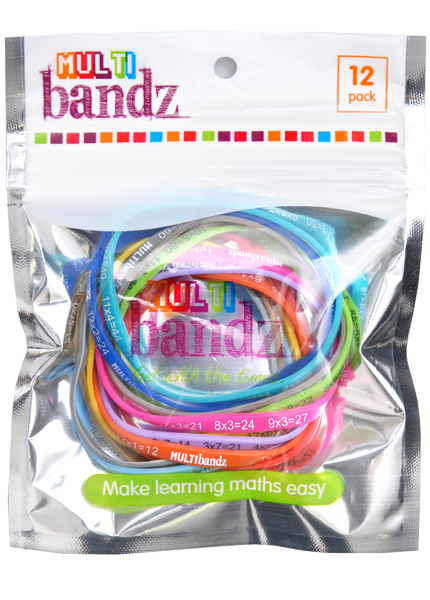
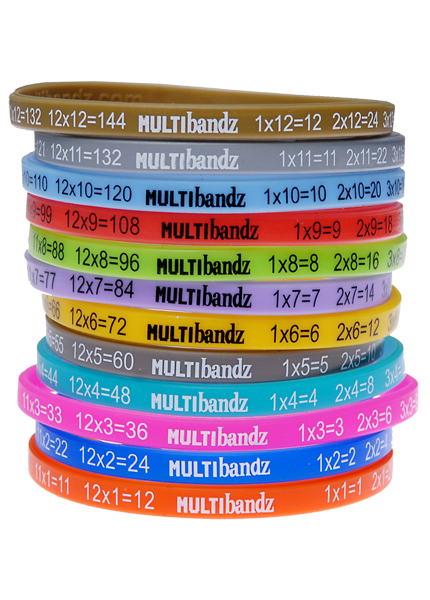
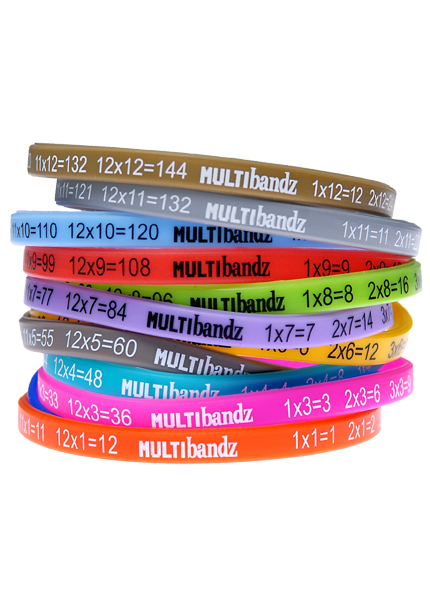
Multibandz are wristbands printed with the multiplication facts for a single times table — one band per table, from the 2s to the 12s. The child wears the table they’re working on, so the facts sit in front of them through the school day: in class, at lunch, on the bus. It is passive, low-pressure repetition with no screen and no nagging.
Because each band covers one table, kids move up a band as they master each one — a visible sense of progress that keeps them going. Buy a single band for the table your child is stuck on, the full 2–12 set, or a classroom pack of 25, 50 or 100.
Shop Multibandz times table wristbands — full set from $11.99 →
For classrooms: a set per student.
Teachers use Multibandz as a low-cost, hands-on aid the whole class can wear — handy for differentiation, since each child wears the table they’re working on rather than the whole class drilling the same one. Classroom packs come in 25, 50 and 100. Bands ship fast from our Sydney despatch, so they can be in the classroom for the start of a unit.
What is the best way to learn times tables?
There is no single best way — the children who learn fastest get the same facts in several formats: a game on Monday, a song in the car, five minutes of flashcards before bed, and a wristband that keeps the table in view all day. Variety stops boredom and the repetition does the rest. Pick three or four methods from the list above, keep sessions short, and rotate them.
Times tables questions.
What age should kids learn their times tables?
In Australia most children start with the 2s, 5s and 10s in Year 2, and work towards knowing all tables to 12 by the end of Year 4. Every child is different, so follow your school’s sequence and focus on one table at a time.
What order should kids learn times tables in?
A common order is 2s, 10s, 5s, then 4s and 3s, building to the 6s, 7s, 8s, 9s and finally 11s and 12s. The early tables have clear patterns that build confidence before the trickier middle tables.
How do times table wristbands help?
A wristband keeps one table in the child’s eyeline all day, so they get dozens of low-pressure glances at the same facts without a screen or a worksheet. It turns idle moments into passive revision, and moving up a band as each table is mastered gives a visible sense of progress.
Do Multibandz come in classroom packs?
Yes. Alongside single bands and the full 2–12 set, Multibandz come in classroom packs of 25, 50 and 100 so every student can wear the table they are working on. Bands ship fast from our Sydney despatch.
Related reading.
- How your child can master maths with Multibandz
- Times table wristbands: tips for maths teachers
- Learning times tables: where kids get stuck
- Maths learning games made fun
Give them a head start on their times tables.
Screen-free, hands-on and worn all day. Single bands, the full 2–12 set, or classroom packs of 25, 50 and 100.
22 years
Designed in Sydney since 2004
Screen-free
Passive practice, worn all day
One band per table
2s to 12s, visible progress
Classroom packs
25, 50 & 100 · fast despatch